


Problem
Solution
Why BRIC is a different kind of challenge
Most federal grant programs are competitive. BRIC is in a category of its own. The program, administered by FEMA through state emergency management offices, receives applications from hundreds of jurisdictions each cycle, spanning all 50 states and U.S. territories. Funding is limited. Selection rates are low. And the application itself is a substantial undertaking: benefit-cost analyses, environmental documentation, hazard mitigation plan alignment, multi-agency coordination, and compliance with FEMA's exacting eligibility criteria all have to come together in a single, coherent submission.
Many agencies attempt BRIC applications and don't make it through. Some never submit. The process is genuinely difficult and the margin between a competitive application and an unsuccessful one is often technical precision, not project quality. That's exactly where B&A’s expertise makes the difference.
What's actually at stake on this shoreline
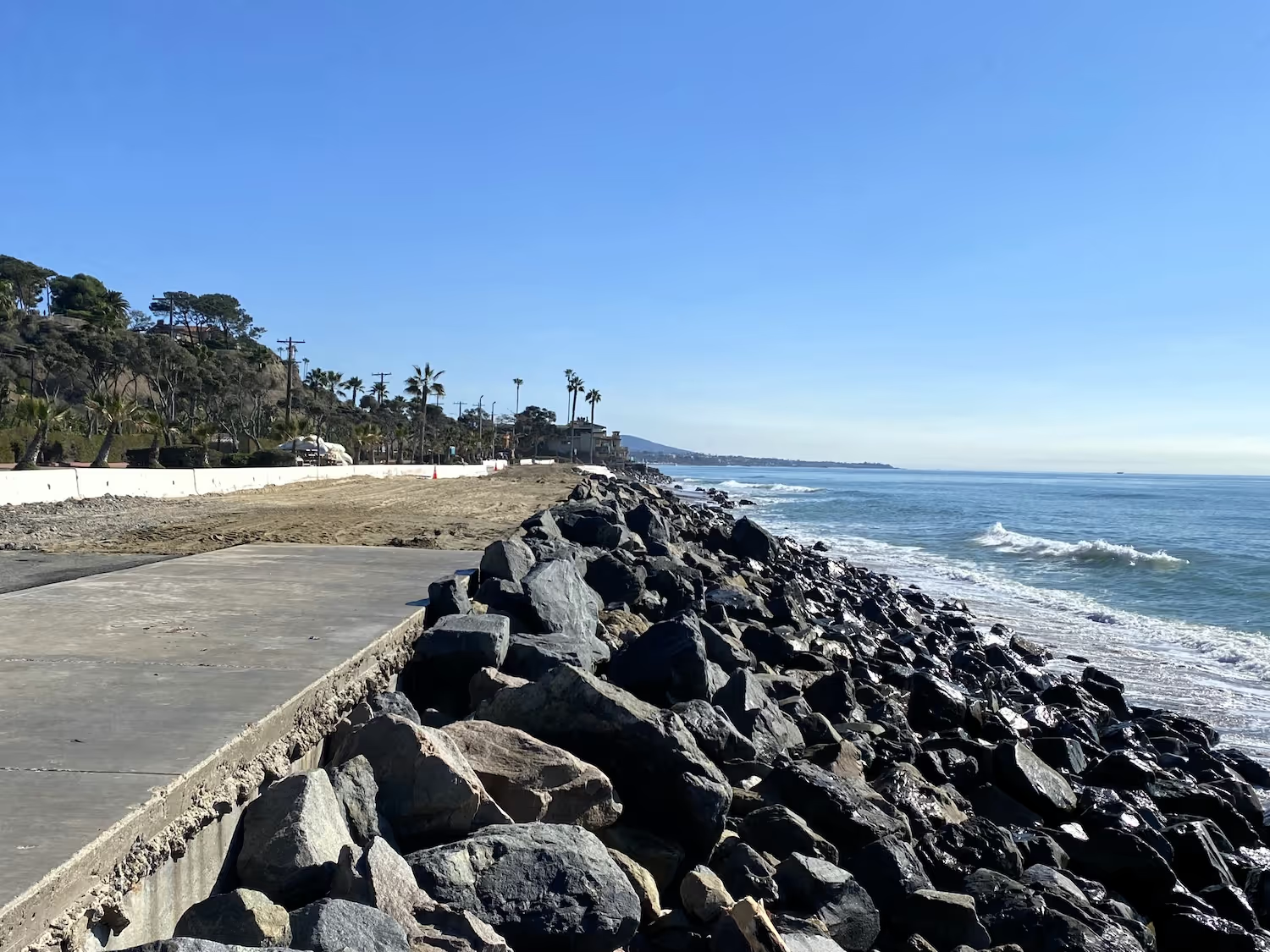
The 1,150-foot stretch of coastline targeted by this project isn't remote beach. It's a thin barrier between the Pacific Ocean and infrastructure that an entire region depends on. Behind the eroding shoreline sits:
- A regional rail line
- Pacific Coast Highway
- A wastewater lift station integral to the local sanitation system
- A water treatment plant serving the surrounding community
- Electrical transmission lines powering the area's grid
Sea level rise is measurable and documented. Storm intensity is increasing. The window for preventive action is narrowing, and the cost of inaction, such as emergency repairs, infrastructure replacement, service disruption, dwarfs the cost of this intervention many times over.
Nature does the heavy lifting
The funded solution is a nature-based coastal berm: a constructed landform of vegetated dunes and cobbles designed to absorb and dissipate wave energy rather than simply deflecting it. Unlike hard armoring, like seawalls, riprap, and concrete, this approach works in concert with coastal processes. It restores shoreline ecology while simultaneously protecting the infrastructure behind it.
FEMA has increasingly prioritized nature-based solutions in its hazard mitigation programs, recognizing that they tend to be more durable, more cost-effective over time, and more adaptive to changing conditions than hard infrastructure alternatives. The alignment between B&A’s proposed solution and FEMA's evolving priorities strengthened the application's standing in a crowded field.
A turnkey process from eligibility to award
B&A didn't hand Orange County Parks a template and walk away. We managed the entire application process: initial eligibility and program fit assessment, project scoping, coordination with CalOES, narrative development, and final submission. Every deliverable was produced to federal standards, and every decision point was navigated with the reviewers' criteria in mind.
That comprehensive approach is what produces results in programs like BRIC. The $9.8M award is the outcome. The process is what made it possible.
What comes next
With federal funding secured, Orange County Parks can move directly into project delivery. The BRIC award funds construction, not planning, not feasibility, not more study. The work ahead is building the berm, restoring the dunes, and hardening the coastline against the conditions that are already here and the ones still coming. For Orange County Parks and the communities that depend on the infrastructure behind this shoreline, that work can't happen soon enough.